Share This With a Friend

Showing posts with label art. Show all posts

Tuesday, September 27, 2011

Classics or clichés?

Last, but not least, avoid clichés like the plague.” ~ William Safire ~

For 30-years, in addition to his political commentaries, Pulitzer Prize-winning journalist William Safire was a master etymologist and grammarian whose column, “On Language” was read weekly in the New York Times Magazine.

Safire’s humorous quote that opened this post has been embraced as gospel by writers everywhere, and has been printed on everything from bumper stickers to t-shirts. Any journalist or novelist who peppers prose with clichés is presumed by his peers to be an amateur, or worse - a lazy writer.

Sometimes however, nothing says it better and faster, or with a minimum of fuss than a good old-fashioned cliché. In my humble opinion, a cliché is “conversational” and hits a verbal homerun without need for additional interpretation.

In everyday one-on-one discourse, I have used numerous clichés. Here are some of my favorites:

“It’s like an Albatross around the neck.”

“Why would you want to pour the baby out with the bathwater?”

“I bet you’ll have to bend over backwards to get that accomplished!”

“I never look a gift horse in the mouth.”

“I think she’ll turn over a new leaf.”

People who live in glass houses shouldn't throw stones.

 “I’m at wits' end!”

“I draw the line at that type of behavior!”

“They’re as close as two peas in a pod.”

“I’m between a rock and a hard place.”

“He’s going to go postal when he hears what happened.” 

“It’s all Greek to me.” 

When it rains it pours!” 

“It’s like putting a square peg in a round hole.”
 
For those of you who enjoy using clichés, or simply want to avoid them like the plague, here is a fun website to checkout – Steven Morgan Friedman’s Cliché Finder, where (at minimum) if you’re a fan of clichés, you will find an index of over 3,300 of the best examples, perfect for verbal use and abuse.

The word cliché is not just relegated to trite or hackneyed sentences or phrases, but the word is also awarded to anything that has become commonplace through overuse – even music and art, hence the picture of Mona Lisa (above) that has come to represent Leonardo Da Vinci’s most celebrated painting.

The video below (thanks to BoredomStrikesU's YouTube Channel) demonstrates music that everyone has probably heard at some point in their life, be it in an elevator, a doctor’s office, watching cartoons and feature films, or while on-hold waiting to speak to an agent from the Internal Revenue Service.

You may not recognize these musical gems by title or composer, but as soon as you hear anyone of these…

1. Eine Kleine Nachtmusik-Mozart
2. Symphony No. 5, 1st mvt-Beethoven
3. Rondo Alla Turca-Mozart
4. William Tell Overature-Rossini
5. Für Elise-Beethoven
6. Blue Danube Waltz-J. Strauss
7. Moonlight Sonata-Beethoven
8. Minuet(from Quintet No. 11)- Boccherini
9. Spring-Vivaldi
10. The Barber of Seville (Overature)-Rossini
11. Dance of the Hours- Ponchielli
12. Also Sprach Zarathustra-R. Strauss
13. Hoedown(from Rodeo)-Copland
14. Prelude to Act 1. (Los Toreadores)-Bizet
15. Adagio for Strings-Barber
16. Classical Gas- Mason Williams

The only tune I think should have been on this list and wasn’t - Pachebel’s Canon in D.


What’s your favorite cliché and classic over-used tune?

Tuesday, February 22, 2011

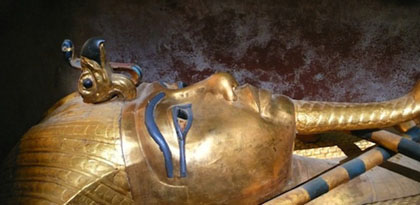
Nat Geo Channel highlights priceless cultural heritage with TREASURES OF EGYPT


A side view of Tutankhamen gold sarcophagus. (Photo Credit: National Geographic Channel)


In light of the historic events that have been unfolding in Egypt, the National Geographic Channel is presenting  — Treasures of Egypt — spotlighting the antiquities of one of mankind’s most significant ancient cultures. Beginning tonight, Tuesday, February 22 and all week long at 8PM ET/PT, Treasures of Egypt will showcase five best of National Geographic Channel’s Egypt programming, with newly produced segments to introduce the subjects of the shows within the context of recent events.

Segments will be hosted by Fox News Channel’s Bill Hemmer, and will include an exclusive interview with Dr. Zahi Hawass, National Geographic Explorer-in-Residence and most recently the Egypt’s minister of state for antiquities affairs. In an interview with NGC, Hawass — who himself has come under pressure and faced criticism in recent days — candidly recounts the break-in at the Cairo Museum in new detail, reveals how some stolen treasures have already been recovered and takes us into the Cairo Museum’s conservation lab to show antiquities that have been restored or are in the process of being restored:

Treasures of Egypt Week

February 22 at 8PM ET/PT Treasures of Egypt:Tut’s Treasures

More than 80 years after the discovery of Tutankhamun’s tomb, the great-grandson of Lord Carnarvon returns to Egypt for a new analysis of Tut’s treasures. With special access to the artifacts in the Cairo Museum, NGC uses the latest techniques to help the real pharaoh emerge — a very different pharaoh than the King Tut we’ve long imagined.

Video below: “Pharaoh’s Curse” – A curse may have found the finder of Tut’s tomb.


February 23 at 8PM ET/PT Treasures of Egypt: King Tut’s Final Secrets

He is the most famous Egyptian king in history, but he ruled for only 10 years before his mysterious death. King Tut’s Final Secrets offers a high-tech forensic investigation that presents new findings from behind the iconic mask, including the first-ever reconstruction of Tut’s face and head using revolutionary 3-D CT scan imaging — revealing what he looked like on the day he died.

Video below: “The Mummy of King Tut” (features Dr. Zahi Hawass) – An archaeologist’s first look at King Tut reveals his mummy to be in worse condition than expected – but how did it get this way?


February 24 at 8PM ET/PT Treasures of Egypt: King Tut and the Lost Dynasty

One of Egypt’s enduring mysteries … what happened to Nefertiti and her husband, the pharaoh Akhenaten, the likely father of King Tut? In a dark and mysterious tomb located in the Valley of the Kings, there is a small chamber with two mummies that scholars, filmmakers and historians have identified as Nefertiti and Akhenaten. But the evidence has been circumstantial at best. Now, for the first time, NGC and Dr. Zahi Hawass use a CT scanner in search of scientific evidence. Narrated by Emmy Award-winning Alfre Woodard, the program documents this high-tech forensic investigation dedicated to resolving the fate of the famed Queen Nefertiti and the possible father of King Tut.

Video below: “Mummy Scan” – Watch scientists scan Egyptian royal mummies.


February 25 at 8PM ET/PT  The Real Cleopatra

Legend portrays her as a self-indulgent temptress who used seduction to cement her rule. But she became queen at 18 and was highly educated, so what was she really like? We’ll reveal archaeological findings, including underwater sculptures that shed light on her life and home. And watch as scientists seek to unravel the mystery of her legendary beauty by converting artifacts with her likeness into a 3-D model, presenting a new reflection of one of history’s most powerful women.

Video below “Last of the Ptolemies” – There’s more to Cleopatra than the Romans would have you believe.


February 26 at 8PM ET/PT  Secrets of the Valley of the Kings

Built over 500 years, spanning nearly two and a half miles and holding 63 tombs, Egypt’s Valley of the Kings is a staggering, complex set of enigmas locked beneath the sands for 3,500 years. What drove Egypt’s greatest pharaohs to seek out this secluded valley? How did the ancient craftsmen achieve such feats of engineering? And why was this sacred site finally abandoned? Join National Geographic Explorer-in-Residence Dr. Zahi Hawass and a team of experts as they uncover new evidence about how early engineers were able to construct the elaborate structures of tombs and chambers.

Video below: “Egyptian Doodles” – Ancient artifacts reveal how Egyptian construction workers sketched and took notes in their free time.


Treasures of Egypt will also include a marathon “stack” of shows on Saturday, February 26, starting at 2PM ET/PT through 8PM ET/PT. For further information on each of the episodes, please click on the highlighted link.

Treasures of Egypt Marathon

Saturday, February 26 at 2PM ET/PT Treasures of Egypt: The Pyramid Code

Saturday, February 26 at 3PM ET/PT Treasures of Egypt: Secrets of the Sphinx

Saturday, February 26 at 4PM ET/PT Treasures of Egypt: The Real Ramses

Saturday, February 26 at 5PM ET/PT Treasures of Egypt: Alexander the Great’s Lost Tomb

Saturday, February 26 at 6PM ET/PT Treasures of Egypt: The Scorpion King

Saturday, February 26 at 7PM ET/PT Treasures of Egypt: Mystery of the Screaming Man

Tuesday, September 7, 2010

Oil painting on an iPad: Oxymoron or art?

"Throughout history a small number of artists have rejected both palette knives and brushes. A few used their fingers to spread the paint. Artists turned to such primal means for various reasons, including display of skill, experimental playfulness, or nose-thumbing at convention. The young Leonardo's use of his fingers can be linked to the properties of the newly available medium of oil painting. ... It should not surprise us that he played with the tackiness of the new oil medium, palpating the paint as he sought new effects." ~ Seeing Through Paintings by Andrea Kirsch and Rustin S. Levenson, p133/4. ~ It’s apparent that Kirsch and Levenson were not referencing Leonardo da Vinci’s “Mona Lisa,” but perhaps the initial youngster-like steps he took to get to the height of his painting career. The art of finger painting in and of itself was rediscovered and popularized by American educator, Ruth Faison Shaw in 1926 while in Rome, Italy teaching at the Shaw School. Since then, finger painting has become a major part of early art education, and used as a significant tool in psychiatric therapy. Earlier this year, in April and May, when the Apple iPad was being launched, I was fascinated with the technology and penned two posts: "The iPad Chalenge: Cat, Dog or Man," and "The iPad Challenge: Part Deux." Frankly, I was impressed with the multitude of inexpensive applications for this gadget, which seemed to be surfacing daily – everything from reading and games to writing and music. I still don’t have an iPad, but I love to paint, and recently I discovered that there is an app called “Brushes”; it has all of the fun of finger painting but none of the mess, and it not only works on an iPad but is available for an iPhone and iPod touch. In case anybody wants to know (hint, hint) this is definitely going on my “wish list.” 

Monday, July 19, 2010

An Unforgettable Face


"In every man's heart, there is a secret nerve that answers to the vibrations of beauty." ~ Christopher Morley ~

The female face has long been inspiration for countless number of artists over the centuries. Take for example the hauntingly elegant oil on canvas that accompanies this post. It is a portrait of 19-year old Amalie von Schintling painted in 1831 by Joseph Karl Stieler, an artist who worked primarily in the service of the Bavarian court.

Stieler painted the portrait at Schloss Nymphenburg in Munich, and endearingly captured von Schintling's hopeful visage. At that time, the young girl was betrothed to her cousin Fritz von Schintling, but sadly would never see her wedding day as she died of tuberculosis shortly after the painting was finished.

Three years ago, St. Louis, Missouri digital artist, Philip Scott Johnson further immortalized Amalie's image in a video, along with that of 89 other beautiful women, all of who had stories of their own to speak from the canvas.

The exquisite video tribute to portraitists and their distaff models displays Johnson’s carefully cropped thumbnail images, which are morphed one on top of the other in a fantasy dance of visual beauty that spans 500 years of Western art.

For two minutes and 53 seconds centuries roll by from face-to-face as we see the passionate works of such artists as Rubens, da Vinci, Reynolds, Winterhalter, Renior and more, as each beauty dissolves and melds accompanied by the sensitive cello performance of Yo-Yo Ma playing Bach’s Sarabande from Suite for Solo Cello No. 1 in G Major, BWV 1007.

Johnson’s outstanding work was recognized with a nomination for Most Creative Video by YouTube for their 2nd annual awards ceremony.

For a complete list of artists and their un-cropped paintings, please follow this link.

Friday, April 24, 2009

Internet art with your youngster: Wrapping artistic genius in tissue paper

How do you get the little children in your life interested in reading and art at the same time?

It’s been 40 years since Eric Carle, the beloved children’s book illustrator and author created one of the most time-honored children’s classics, “The Very Hungry Caterpillar,” and Carle’s instructive web site is an ideal starting point for garnering pint-sized interest, and sparking creative exploration along with a trip to your local library or bookseller.

This year marks a milestone of sorts for the evergreen story - it has been translated into 47 languages and has sold over 29 million copies worldwide.

“The Very Hungry Caterpillar” actually began as “A Week with Willi the Worm,” and fortunate for Carle that he took his editor’s suggestion to heart (to transform a plump, green Willi into a multi- color-splashed caterpillar) because it was the caterpillar that has become his most famous work, even though to date he has illustrated or authored a combined total of 70 other books.

Carle, a grandfatherly image, says about his littlest fans, “Growing up can be very difficult – I like to help children along.” And, that he does, as he shares his techniques in a step-by-step fashion that can be mimicked by moms, dads, extended family or caretakers, (who incidentally will probably have just as much fun as the youngsters) painting colorful tissue papers and assembling your very own collage.

This year Carle celebrates another milestone – his 80th birthday. He keeps engaged and active - commuting between two households; the museum of picture book art that bears his name in Western Massachusetts; a host of book signings and even writing his own blog.

How many of you have treasured memories of being read Carle’s wonderful tale?